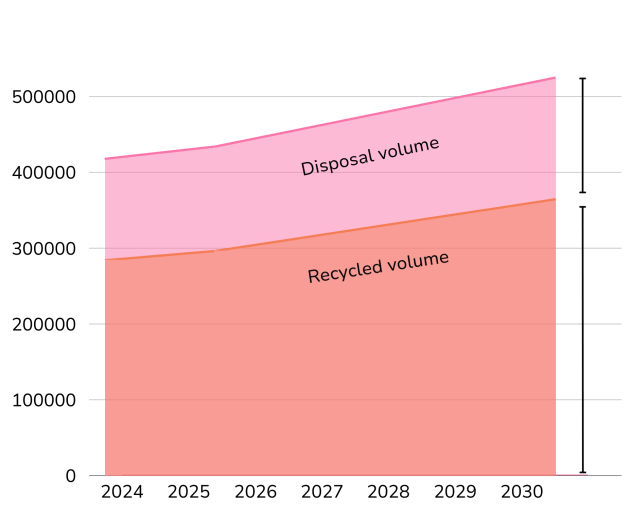
Global packaging waste will total 434.5 million tonnes in 2025 and rise to 525 million tonnes by 2030, according to new research from Smithers. The report shows a compound annual growth rate of 3.9 per cent.
In 2024, the average person generated 53kg of packaging waste, with 36kg recycled and 17kg discarded. By 2030, this is projected to increase to 63kg per person, with 44kg recycled and 19kg discarded.
Recyclability and waste collection remain key pressures shaping packaging design over the next five years. Smithers’ latest report, The Impact of Recycling and Waste on the Packaging Industry to 2030, details how these factors influence material choices.
Plastics continue to dominate global sustainability discussions. Between 2000 and 2019, plastics waste volumes doubled, with packaging representing around 40% of the total. Global plastics recycling rates were 27.9 per cent in 2024. Smithers says improvement is expected through the rollout of ‘super-clean’ mechanical recycling technologies for rigid PET and HDPE. Recycling options for other polymers, particularly flexibles, remain limited, though recovery is forecast to increase as mono-polymer structures become more common and chemical recycling develops. Financial incentives for converters include extended producer responsibility schemes and recycled-content mandates.
Fibre-based packaging including paper, cartonboard, corrugated and moulded formats recorded a global recycling rate of 76.2 per cent in 2024. Rates reached 88.3 per cent in Europe and 94.5 per cent in the US. Smithers reports that yields will improve with upgraded repulping systems that offer better de-inking and reduce contamination.
Glass achieved a global recycling rate of 88.6 per cent in 2024, supported by improvements in colour sorting and contaminant removal. Metal packaging recorded a worldwide rate of 93.1 per cent, with Europe leading at 95.5% and North America at 89.4 per cent. Collection remains the main barrier to further gains.
Across all materials, efficiency is expected to increase with improved sorting, washing and decontamination equipment, as well as the integration of AI with automated sorting systems to enhance the purity of recovered streams.
The Impact of Recycling and Waste on the Packaging Industry to 2030 is available from Smithers for $6,750 (€6,350, £5,475).