When packaging and paper company Mondi Group was approached to supply materials to produce cement bags to supply a scientific research station, it was also presented with a challenge few packaging companies ever face – to ensure the bags were able to handle the most hostile climatic conditions on the planet, in Antarctica.
Mondi, based in Austria, had long proven the durability of its Advantage Select sack kraft paper to produce two-ply cement bags for locations in Asia and Africa.
Conditions in Antarctica, however, were a whole order of magnitude more adverse than those posed by any of these previous projects.
Antarctica is the coldest, windiest, and driest place on earth, with a desert climate, air humidity near zero, and almost no rain. The average annual temperature is -47C, with possible temperatures as low as -89.2C.
The prime focus of human activity on the continent is scientific research, with scientists and networks that support them living in research stations across the continent that must be constructed with cement.
Recently, Korea's Taemyung Industrial Co was requested to produce 40kg cement bags by Ssangyong Cement Industrial Co to be delivered to Antarctica.
Taemyung specified the consistent performance of the bag was imperative, not only having to contend with the expected wide range of temperatures and climatic challenges, but also rugged enough to be handled, moved, carried and dropped throughout the supply chain up to 10 times and needing to survive multiple drops from packers, trucks, pallets and warehouse stacks with heights ranging from one up to three metres.
As a previous Mondi customer, Taemyung felt its sack kraft paper would be up to the task, offering superior tensile energy absorption (TEA) combined with high porosity.
Using the paper also meant the cement bags could be lighter and cheaper, with the two-ply construction possibilities they offered achieving material savings of up to 25 per cent over competing three-ply bags.
“These 2-ply bags are the strongest in the marketplace which means two things for our customers: reduced breakages, and more efficient dust-free filling on the rotopacker as bags no longer require perforation,” the managing director of Mondi's Asian packaging paper sales, Gerry Gosen, said.
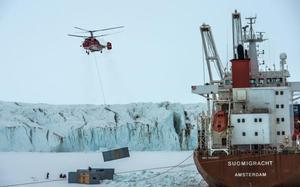 Containers with cement bags being unloaded in Antarctica. The Mondi paper used in these bags enabled them to withstand the continent's severe climatic conditions, as well as tough handling on the way.