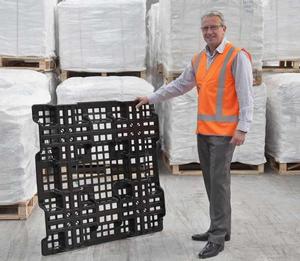
• Bulk Handling Australia's managing director Ian Shaw with the company's new bulk export pallet.
    Bulk Handling Australia's managing director Ian Shaw with the company's new bulk export pallet.
Close×

Early sales of Bulk Handling Australia's [BHA] new bulk export pallet (PKN, February 2013, p.8) have exceeded initial expectations,  with half of its original manufacture run already sold through to industry.

BHA managing director Ian Shaw said the revolutionary pallet, developed over two years as a low cost alternative to export-grade wooden and traditional plastic pallets, had achieved sales to such significant companies as Simplot in the food industry, Qenos in the chemical industry, and agricultural services company Genetic Seed Technologies.

“We are very encouraged by the initial take up of our new export pallet with 5000 [units] of our initial manufacture run already sold in the first four weeks,” Shaw said.

“We also have multiple companies in the food industry currently trailing the product to confirm its application in their fill systems and with their end user customers.

The slim-line design of the pallet, which was officially launched on the Australian and New Zealand markets earlier this year, translates to a stack of ten BHA pallets measuring just 280mm in height.

“This means customers can develop a closed loop with end users for a cost effective return freight of 2100 BHA Bag Pallets per 40 foot container load,” Shaw said.

The pallet is injection moulded from high density polyethylene (HDPE) and is designed with four-way entry, is stackable to save space, and fully recyclable.

Food & Drink Business

End Food Waste Australia (EFWA) and Hort Innovation have launched a new research program to tackle the challenges of harvest surplus and losses on-farm – a $2.5 billion opportunity for vegetable growers.

The federal government has confirmed it will not proceed with the Tax Laws Amendment (Incentivising Food Donations to Charitable Organisations) Bill 2024, saying the legislation contains “deficiencies that compromise its policy intent”, even as food insecurity remains at record levels across Australia.

A lot of food and beverage brands look strong when they’re small. They have one product, one pack, one clear idea and then they grow. That’s usually when things start to unravel, not all at once, but quickly enough to matter. The Creative Method founder and creative director, Tony Ibbotson, explains why – and growth is not the problem.