Woolworths’ Victorian stores will reduce the amount of food waste sent to landfill through the use of Veolia's new depackaging facility in Dandenong South.
Woolworths is already well-advanced on its recycling and reuse journey for food, but expired packaged food that wasn’t suitable for charities has remained a challenge.
Veolia’s state-of-the-art depackaging facility, which has the capacity to process up to 15,000 tonnes of packaged food every year, has changed all that for the supermarket giant.
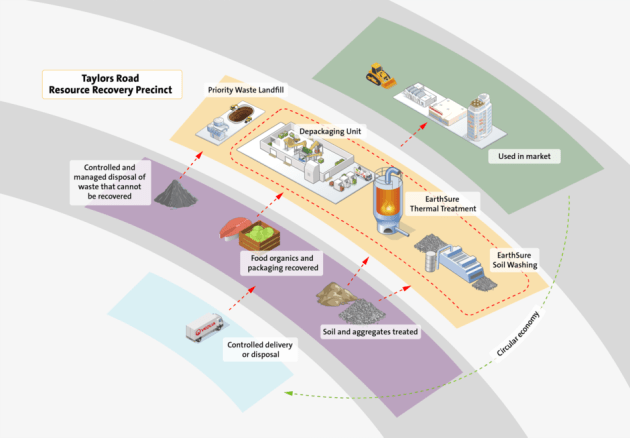
The facility automatically strips the packaging from the expired food and separates them, enabling Woolworths to process the expired food and turn it into high quality compost, while giving the packaging a new life as a recycled resource.
The only products that Woolworths will send to the facility are those that are not suitable for charities, and since turning to Veolia, very little of its packaged food waste now goes to landfill.
“Every time we help one of our clients, like Woolworths, divert and reuse more organic waste, we help reduce the amount of greenhouse gases generated by landfill and enable organic resources to be returned to the earth. It’s a win-win for everyone,” said Mark Globan, GM of Resource Recovery – Vic at Veolia.
“Finding and developing sustainable solutions for business is so much a part of the bones of Veolia that even our Taylors Road Resource Recovery Precinct, which houses the depackager, is an example of reuse.
“The entire depackaging facility is made up of repurposed components taken from other Veolia sites and the shed that houses the facility already existed on site and was modified to accept the depackager. We believe in walking the talk where sustainability is concerned.”
The depackaging facility is the latest innovation Woolworths Group has brought to bear on its path to sustainability.
The Group diverted 80 per cent of food waste across its total operations from landfill in the last financial year, and Veolia’s depackaging facility will help save more food from landfill.
“When it comes to food we can’t sell, our first choice is always to give it to our charity partners to help feed people in need,” said Paul Donaghy, 360 resource recovery manager at Woolworths.
“But, sometimes that’s not an option because the food is no longer edible – but that doesn’t mean it has to go to landfill.
“While we use a range of services to save inedible food from landfill, one of the biggest challenges is separating packaging from the food inside. This depackaging solution will help us continue to close the gap on food waste by ensuring packaged foods can be efficiently and effectively processed.”
The depackaging facility is just one of many technological innovations that Veolia makes available to its clients to increase recycling and reuse rates as Australia moves towards becoming a fully circular economy.
“One of the fundamental pillars of Veolia is the phrase ecological transformation, which describes those actions where we depollute, decarbonise and preserve the environment,” Globan said.
In the coming year, Australians will see an acceleration of this approach from Veolia, as its new GreenUp strategy comes online, boosting investment across the country that will see the company provide a multitude of circular economy, energy and sustainable options for its customers.