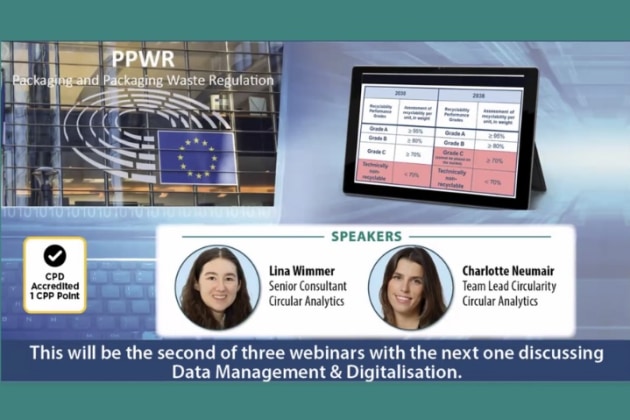
The Australasian Institute of Packaging (AIP) today continued its three-part series on the EU Packaging and Packaging Waste Regulation (PPWR), with Circular Analytics’ Charlotte Neumair and Lina Wimmer guiding attendees through the practical steps companies must take to comply with the regulation particularly those exporting packaged goods into Europe.
This session followed part one, which outlined the PPWR framework, core objectives and key milestones; Part two moved the discussion into implementation and operational requirements.
Neumair reminded attendees that the regulation differentiates clearly between five economic operators, supplier, manufacturer, producer, importer and distributor and that obligations are not equal. “The PPWR actually defines five economic operators,” she said. “Each and every economic operator has different obligations,” with producers and importers required to assess conformity and draw up technical documentation, while distributors must verify that packaging is compliant before placing it on the market.
For importers, the message was uncompromising. “As an importer you are only allowed to place packaging on the EU market which is in conformity with the requirements set in Articles 5 to 12,” Wimmer said. These provisions cover substances in packaging, recyclability, minimum recycled content in plastics, compostability for specified items, packaging minimisation, reusability and labelling.
She noted that non-compliant packaging may be withdrawn or recalled, “If your packaging is non-compliant… you either have to ensure conformity, or the packaging would be withdrawn from the market or recalled, depending on whether it’s already placed on the market or not.”
Conformity assessment and declarations of conformity
Wimmer walked through the PPWR’s conformity assessment procedure, which spans internal production control, technical documentation, manufacturing controls, the declaration of conformity, and where applicable, an authorised representative holding the documentation. The technical file must describe the packaging, list applicable standards and specifications, and include qualitative assessments of recyclability, minimisation and reusability, supported by test results where relevant.
“With the declaration of conformity, you have more or less the key to the EU market,” she said. The document “is a legal document stating that the packaging meets all the EU requirements… and it is required for each type of packaging which you will place on the European market”.
Importers must also be ready to respond quickly to enforcement authorities within ten working days. For single-use packaging the documentation must be retained for five years, and for multi-use packaging for ten years.
Neumair later summed up the stakes, “If you do not have a declaration, there is no market access without valid documentation. There is the possibility that your goods can be blocked at the EU borders already.”
Timelines, targets and the case for proactive compliance
The speakers revisited key deadlines already flagged in Part 1. From 12 August 2026, packaging placed on the EU market must comply with Article 5 on substances, including PFAS and heavy metals. From February 2028, harmonised labelling requirements and compostability obligations for certain packaging items apply. On 1 January 2030, Articles 6, 7 and 10 enter into force, introducing the 70 per cent recyclability threshold, minimum recycled content levels in plastics, and packaging minimisation rules.
Reusability requirements will ramp up over time, particularly in B2B applications. Neumair encouraged companies to “plan these reusable systems when you need to change them early enough that you have enough time to adapt”.
She warned against assuming there will be time to retrofit compliance at the last minute, “The time is tight… when a packaging is not recyclable today, there is no magic that will make it recyclable in 2030.” Proactive action, she argued, will differentiate exporters. “We believe proactive compliance is a competitive advantage,” she said, adding that “sustainability is a market access requirement”.
Data, status-quo analysis and digital systems
A recurring theme was the centrality of accurate packaging data. Neumair recommended companies start with a status-quo analysis, “Ask yourself, what role do I play in the game of PPWR? What are my responsibilities?” Once roles are clear, businesses must confirm whether they hold the information needed for conformity assessment including packaging weight, material, dimensions and additives.
“It is very important to have a good communication along the supply chains that we get the data that we need,” she said, noting that suppliers will often hold key technical details. Given the volume of data and declarations required, she advised moving quickly to digital platforms so you can have a good record of your packaging data.
Neumair closed her presentation with a call to action, “Now it’s time to take action and really stay on track of this groundbreaking regulation. Start with status-quo analysis, check the data if you have everything you need, and ensure the conformity to see if you already meet all the requirements, or if there are any gaps you need to fulfil in the next years.”
Part 3 of the series, to be held in early 2026, will delve deeper into data management and digitalisation using tools such as Circular Analytics’ Packaging Cockpit.
Looking ahead
The webinar underscored that for companies exporting to Europe, PPWR preparedness now hinges on three pillars: understanding one’s legal role in the supply chain, building robust technical documentation and declarations of conformity, and investing in systems to capture, store and analyse packaging data.
As Wimmer put it, the declaration of conformity is now “your ticket for EU market access”. For Australian businesses, the clear takeaway was to begin this work well ahead of the 2030 recyclability and recycled-content deadlines and to monitor how Europe’s approach may shape future regulation closer to home.