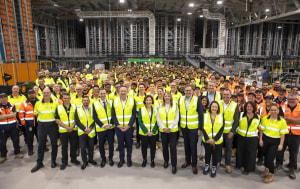
Coca-Cola Europacific Partners (CCEP) has commissioned a $75 million high-speed canning line at its Richlands, Brisbane facility – the largest in its global network – capable of producing 120,000 cans per hour. Primarily serving Monster Energy products, the line is designed for rapid format changeovers, reduced environmental impact, and precision quality control.

CCEP Australia managing director, Orlando Rodriguez, said the investment underscores the company’s confidence in the Australian beverage market and its production and packaging operations.
“For almost 90 years we’ve been manufacturing beverages in Australia, and this investment is the next major step in our commitment,” Rodriguez said. “Over the last decade, we’ve invested more than $900 million in the Australian supply chain – predominantly in manufacturing, systems, and logistics – and there’s more to come.”
The project aligns with Monster Energy’s rapid growth, with the energy drinks category expanding by almost 20 per cent year-on-year. Monster now holds nearly 40 per cent of category volume share, driven by strong performance in sugar-free SKUs.
Designed for speed, versatility, and sustainability

The line integrates advanced packaging technology from leading suppliers to enhance flexibility and efficiency. KHS was the turnkey supplier, and also supplied one of three packers (the other two came from WestRock) and the filler. AGVs were supplied by Dematic and the can seamer by Ferrum.
This combination supports a range of pack formats and allows the line to respond quickly to changing consumer and retailer demands – from value packs for price-sensitive markets to premium multi-packs for high-growth channels.
A key sustainability win comes from the Sismatico air-only can body rinser, replacing water-based rinsing and eliminating water use in the cleaning stage. This simple change delivers immediate environmental benefits and reduces operating costs.
Packaging quality control: precision at scale

The production floor features a BBull inline dual empty can inspection system that detects dents, creases, partial codes, or contamination before filling, ensuring only compliant packaging enters the line.
At the heart of the process is a fully automated quality lane equipped with an X-ray unit and robotic seam analyser from CMC Kuhnke – delivering 20 times more seam checks than manual methods, performing non-destructive testing so compliant cans return to production. Also in this zone, The Wipotec high-speed checkweigher samples 300 cans per hour for weight verification – 30 times faster than traditional manual checks – enabling real-time adjustments and reducing waste.
These systems not only protect packaging and product integrity but also generate extensive data for predictive maintenance, driving higher efficiency and less downtime.
Building Australia’s packaging future
By the end of 2025, CCEP’s total Australian investment will approach $1 billion. Rodriguez said the strategy is about anchoring production geographically to “invest, make and sell locally”. He added: “Investment creates jobs, fuels growth, and builds partner confidence to invest in marketing – all of which strengthens our packaging and manufacturing ecosystem.”
The project was delivered by Wiley, with integrated packaging systems designed to meet the twin demands of speed and quality while setting a new benchmark for sustainable canning operations in Australia.