
• Renewable Neste RE consists of pure hydrocarbons made from bio-based raw materials and can be used as a drop-in solution to replace fossil feedstock in the making of polymers and chemicals.
    Renewable Neste RE consists of pure hydrocarbons made from bio-based raw materials and can be used as a drop-in solution to replace fossil feedstock in the making of polymers and chemicals.
Close×

A collaboration between Neste, Eneos, Suntory, and Mitsubishi Corporation plans to produce PET resin from biomass, which will be used to manufacture bio-based bottles next year.

Neste RE will supply the feedstock – a solution it claims is made entirely from raw materials, waste, and residues such as cooking oil – which will be used by Eneos to produce bio-paraxylene (bio-PX) at its Mizushima Refinery in Okayama, Japan.

This bio-PX will be converted into purified terephthalic acid, or PTA, and finally into PET resin. Suntory says it will then use the resin to create PET bottles, using a mass balance approach to allocate the bio-based materials to the PET bottles.

Mitsubishi Corporation will be responsible for managing this entire supply chain.

“In order to tackle the imminent climate crisis and its consequences, companies are required to take responsibility now,” said Lilyana Budyanto, head of Sustainable Partnerships APAC at Neste Renewable Polymers and Chemicals business unit.

“Through partnering along the value chain, Neste can contribute to reducing the polymers and chemicals industry’s dependence on fossil resources as well as to manufacturing of products that have a lower carbon footprint.”
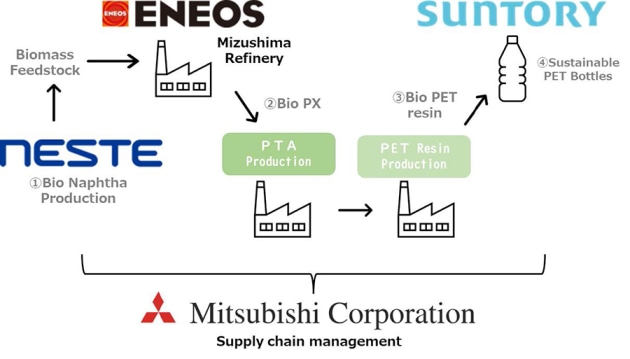
The supply chain will be overseen by Mitsubishi

Food & Drink Business

Almond processor Select Harvests has announced the resignation of CEO and managing director, David Surveyor, marking the end of a three-year tenure that saw the business return to profitability.

Australia has long been a major exporter of fresh produce, with its agricultural sector playing an important role in supplying global food markets. Lineage director business development, Christian Rossow, looks at why the infrastructure connecting producers to ports and global supply chains is just as vital as product quality.

Automated intralogistics solutions company, Swisslog, is strengthening the resources available to its Australian and New Zealand (ANZ) customers through a new structure for the Asia Pacific excluding China (APeC) region.