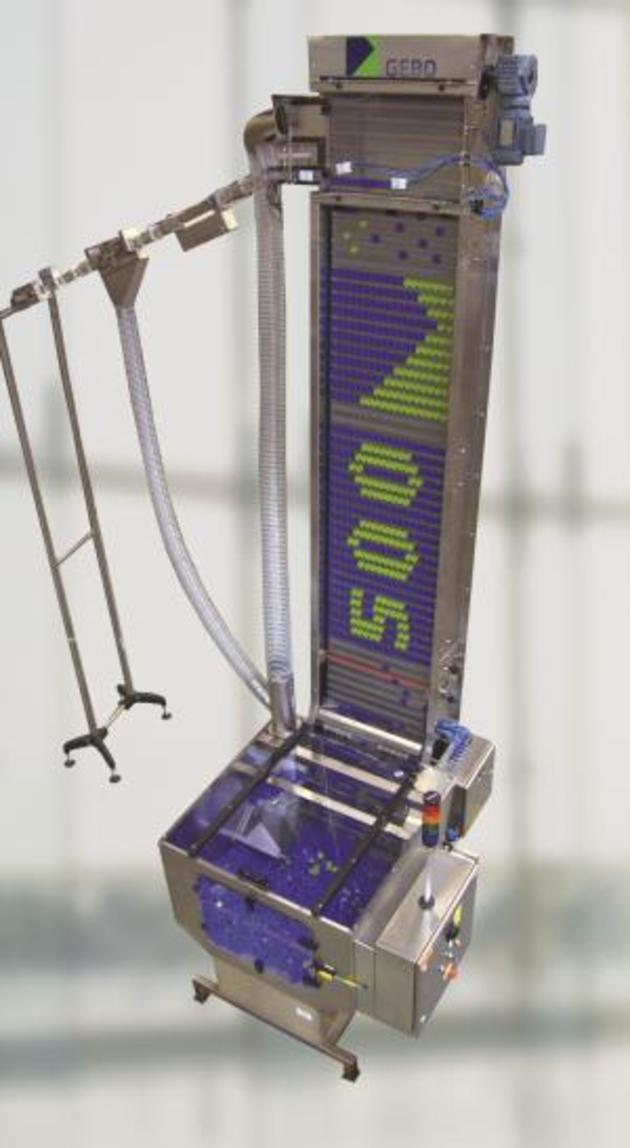
• Gebo Aidlin Cap Feeder
    Gebo Aidlin Cap Feeder
Close×

At the beginning of 2014, the Gebo plant in Reichstett, near Strasbourg, delivered its 500th Aidlin cap feeder. And the 25th anniversary of its development. During those two and a half decades, the cap feeder has had to adapt to very many new, and increasingly complex, caps. It has conquered every challenge and there is every reason it will continue to do so.

The complete Aidlin range is based on a principle of orientation of caps by gravity, known as the Waterfall technique. Whatever the type of cap, throughput or market segment, Gebo cap feeders adapt to all configurations and conditions. The machine takes the caps stored in bulk in a hopper at ground level, lifts them via a belt equipped with cleats, and orientates them according to a simple, efficient gravitational principle. Any improperly positioned cap falls back into the hopper, and only properly oriented ones continue towards the capping machine. And so, Aidlin cap feeder perfectly secures supply to the capping / filling machine with an efficiency rate of more than 99.5% at low, medium and high throughput.

Because the Gebo cap feeder orientates the cap outside the filling zone, dust does not fall into products. This hygience feature is key for sterile bottling lines, aseptic packaging, or beer using flash pasteurization technology before filling.

Gebo has always been able to adapt Aidlin cap feeders to accompany new market trends like sports caps. This capacity for innovation has made it optimal for all uses: CSDs, water, fruit juice, beer, body care products and detergents. For example, Gebo was the first equipment supplier, and indeed the only one to date, to have the necessary know-how to integrate Waterfall technology into their high-throughput beer lines with crown caps.

Every major market is served by a dedicated Gebo site, which adapts the machines to local conditions to reduce transport costs. Oceania has also just been given a new Gebo sales and services expert, Franck Ellenbogen, based in Sydney. Franck holds a Master’s degree in Business Engineering and Project Management and seven years experience within the Gebo Cermex, most recently in charge of Gebo Cermex for the foods sector across the US. To contact him with any enquiry click here.


Food & Drink Business

Australia’s ‘cheese-centric’ dairy industry is looking to higher-value uses of milk protein – such as nutritional supplements – as national milk production remains low, according to Rabobank.

Tucking into a hamburger without harming animals is closer to reality after University of Queensland (UQ) researchers found a way to cut costs in cultivated meat production.

Sixteen months after receivers were appointed over its holding company, the structural obstacle to selling Western Australia’s largest milk processor has been removed. McGrathNicol has launched the formal sale process for Brownes Dairy, with China Mengniu Dairy Company consolidating its holding position so the entire enterprise can be put to market rather than a shareholding above it.
