CHEP Australia has launched a new state-of-the-art centrifugal dryer technology it says will deliver fresh produce crates that are 80 per cent drier than those processed through tunnel dryers.
Installed at the company's Scoresby service centre in Victoria, the technology complements CHEP’s HACCP crate wash system and also uses up to 80 per cent less energy compared to existing blow dryer technology.
“With the new dryer we can now supply crates with less than three grams of water,” CHEP’s senior director – supply chain, David Hansen, said.
“This will be ideal for fruit and vegetables that require very low moisture environments, such as onions, and will widen the opportunity for growers to benefit from CHEP’s reusable plastic crates solution.”
The new system uses centrifugal force to remove almost all of the excess water from crates. It's also designed to self-generate power to achieve its energy savings.
During the rotor’s deceleration phase the machine uses the spinning motion to generate power which is then used for the next spin cycle. Hansen said that while conventional tunnel dryers use approximately 150kW of power in equivalent operations, the centrifugal drying technology uses as little 9kW.
Hansen said these savings also extend to the water used in the crate washing process.
“We catch the clean water spun from the crates in a water collection tank before pumping it back into the washer for reuse and by doing this save around 180,000 litres of water a year,” he explained.
Following its introduction in Victoria, the dryer will be incorporated in CHEP's New South Wales and Queensland operations early in 2014, Hansen said.
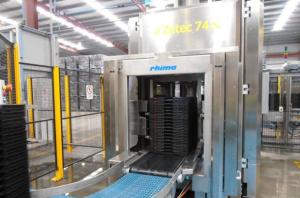 CHEP's new fresh produce crate dryer technology results in 80 per cent water and energy savings over conventional crate dryer technology, the company says.



