


Glass and rigid plastics are set to lead the growth in consumer packaging over the next three years, with the market driven by the need for convenience, according to a new report.
The GlobalData report, Australian Packaging Industry – Trends and Opportunities indicates that due to hectic lifestyles, consumers are increasingly opting for products that are offered in convenient packaging formats. It says that in Australia this shift is playing a primary role in the growth of the packaging sector, which is expected to reach 35.8 billion units in 2024, at a compound annual growth rate (CAGR) of 1.2 per cent.
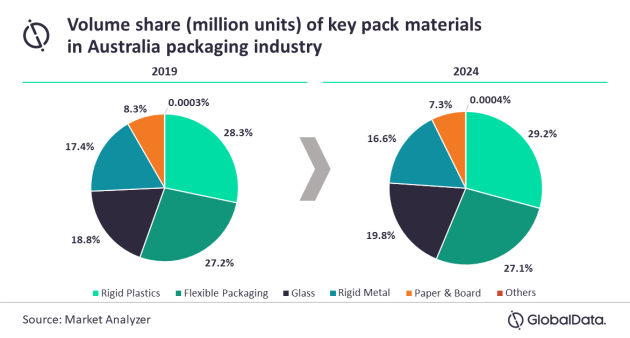
Glass packaging is forecast to register the fastest volume CAGR, of 2.2 per cent during 2019-2024. The category will be closely followed by rigid plastics, which is expected to record a CAGR of 1.9 per cent over the next three years. Flexible packaging will remain stable, while paper and board is forecast to lose about 10 per cent of its market share. Rigid metal will also decline, according to the report.
Anchal Bisht, consumer analyst at GlobalData, says: “Hectic lifestyles and change in consumption patterns are pushing consumers towards products packed to offer convenience and support on-the-go consumption. The trend is particularly strong in sectors such as food, beverages and cosmetics.”
The food industry in Australia accounts for 48.1 per cent market share of packaging, followed by non-alcoholic beverages and alcoholic beverages, with shares of 18.8 per cent and 18.7 per cent, respectively.
Rigid plastics was the most consumed pack material in Australian packaging industry and accounted for a market share of 28.3 per cent in 2019. It is expected to reach 29.2 per cent by 2024. Flexible packaging and glass were the other popular pack materials.
The food industry led in terms of usage of rigid plastics, with a share of 55.2 per cent in 2019. It was followed by the non-alcoholic beverages industry which accounted for a share of 33.8 per cent in the same year.
Bisht concluded: “Sustainability is yet another trend gaining ground in the sector, pushed by rising consumer consciousness over issues of environmental degradation as well as the government-led targets for 2025 to shift towards sustainable packaging. Changes in consumer attitude towards environmental issues are significantly impacting products’ choices and prompting the manufacturers to innovate on this front.”


