


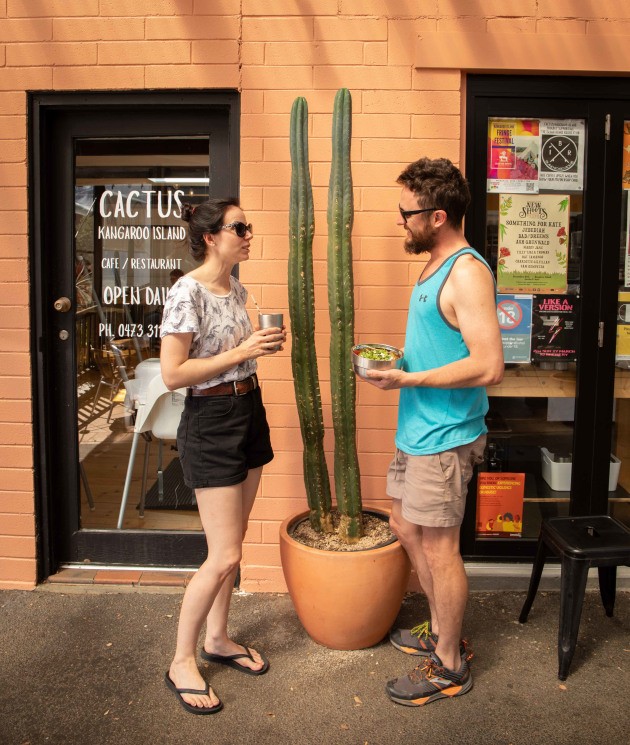
Kangaroo Island has been chosen as the launch site of a technology enabled pilot programme for reusable coffee cups and takeaway food containers.
The programme is headed by a group of like-minded University of Adelaide eChallenge competitors interested in sustainable food and beverage practices.
The four members of the Reusably team dreamt up the idea after meeting during a series of eChallenge workshops run by the Adelaide Business School.
Mary Kelly and co-founders Matt Bowie, Filip Rajec and Tom Nicholls have joined with local businesses and organisations on the island to bring the innovative program to reality.
“There has been a move to compostable packaging in recent years, but it still has its drawbacks as this needs to be collected free of contamination from other waste, which means in a lot of places they aren’t suitable for composting,” said Bowie, who wrote his PhD on sustainable coffee practices and consumer behaviour change.
“The stainless-steel containers we are trialling here for the first time address that issue as they are reusable, made from 75 per cent recycled content, and there is demand for recycled steel.
“The issue of waste from takeaway food and drink containers is now of serious concern, given the volume of resources making its way into landfills, polluting our beaches and waterways and littering our streets,” said Bowie.
“This includes tens of thousands of plastic and paper coffee cups that have various coatings, making recycling or composting more challenging.”
After three years of research and testing, the trial begins in Kingscote, Kangaroo Island, thanks to the community’s support and its desire to explore innovative solutions to waste. From there, the team hopes to expand and bring the plan to fruition commercially.
As well as community applications, the technology has multiple uses across various industry supply chains.
The way it works is similar to the way the popular city e-scooters and bikes are accessed – an app will allow users to pick up coffee or takeaway food from a participating café or restaurant in one location, then drop the containers back at another.
They are all made from durable stainless steel, so the Australian-designed containers can be washed in a commercial dishwasher – which safely addresses hygiene concerns that have dogged similar operations in the past.
“The cups and containers were designed in Melbourne and are double-walled, which is important for ease of use by customers, and also keeps the coffee and food at the right temperature,” Bowie explained.
“Of course, the other advantage is that they are extremely durable and are easy to wash properly, which means they are safe from that standpoint.
“We decided to trial this on the island – six outlets are taking part and more coming on board, which so far is most of the places in Kingscote. It’s a three-month pilot and we hope to grow from there.”
Bowie said that the pilot is just one small, but classic example of how the University’s post-graduate programs can lead to commercial opportunities, and start-ups that aim to bring fresh ideas, jobs and investment in SA.
“Obviously we are very excited, and in one way or another, we have been brought together through our activities within the University, which has opened a number of doors for us along our journey,” Bowie concluded.


