


Ferrero has reported further progress on packaging circularity in its 2025 Sustainability Report, with almost 93 per cent of its packaging now designed for recyclability, reusability or compostability, alongside continued reductions in plastic use across its flagship Ferrero Rocher range.
Ferrero says packaging remains a key part of its broader sustainability strategy, with circular design featuring alongside climate action, responsible sourcing and community initiatives in the company's 2025 Sustainability Report.

Released as the confectionery manufacturer marks its 80th anniversary, the report outlines progress across four sustainability pillars – protecting the environment, sourcing ingredients sustainably, promoting responsible consumption, and empowering people – while positioning its enhanced Ferrero Farming Values framework at the centre of its responsible sourcing strategy.
Among the packaging highlights, Ferrero reports that 92.9 per cent of its packaging is now designed for recyclability, reusability or compostability. It says 86.8 per cent of packaging is recyclable, reusable or compostable "in practice and at scale", reflecting the availability of collection, sorting and recycling infrastructure.
The company also continued work to align its packaging portfolio with Europe's Packaging and Packaging Waste Regulation (PPWR), which chief executive officer Lapo Civiletti said would help the business stay ahead of evolving regulatory requirements while advancing packaging designed for circularity.
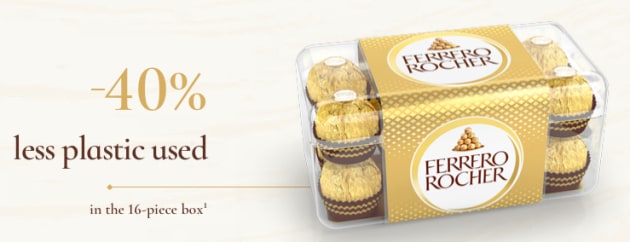
One of the report's most tangible packaging outcomes is the ongoing redesign of Ferrero Rocher boxes. According to Ferrero, the redesign has reduced the plastic-to-product ratio by 14.7 per cent compared with its 2019/20 baseline, avoiding approximately 16,000 tonnes of plastic since the project began rolling out in September 2021.
The report also notes a 3.5 per cent year-on-year increase in the use of renewable materials in packaging, alongside continued efforts to reduce greenhouse gas emissions across manufacturing and logistics. Overall Scope 1 and 2 emissions fell 7.2 per cent during the reporting period, supported by 24 manufacturing plants now operating on 100 per cent renewable grid electricity.
Beyond packaging, the report places significant emphasis on supply chain resilience through responsible ingredient sourcing. Ferrero reports achieving 98 per cent traceability to farm polygon maps for cocoa, 98.6 per cent traceability to plantation for palm oil, 97 per cent traceability to farmer for hazelnuts, and 100 per cent traceability to plantation polygon maps for coffee. It also analysed almost 230,000 supply chain polygons as part of its European Union Deforestation Regulation (EUDR)-aligned monitoring program.
Giovanni Ferrero, president of Ferrero Group, said the company's long-term success remains closely linked to the health of the people and ecosystems that support its supply chain.
"Consumers are increasingly looking for brands they can trust – built on quality, good sourcing practices, careful manufacturing, and a genuine commitment to people and the planet," he said.
"Guided by our purpose and long-term vision, we will continue supporting initiatives related to the protection of natural resources, the support of our people, communities and partners and the creation of products that delight consumers for generations to come."
Chief executive officer Lapo Civiletti said the newly enhanced Ferrero Farming Values framework provides a structured approach to strengthening supply chain resilience.
"It provides a structured framework to strengthen supplier accountability, improve traceability and certification, support farmers, and drive collaboration across the sector – while allowing us to adapt to the specific realities of each ingredient supply chain."
The report is Ferrero's 17th annual sustainability report and covers the 2024/25 financial year. It reports consolidated turnover of €19.3 billion (approx AU$32bn), with the company operating 36 manufacturing plants and selling products in more than 170 countries.


