


From glue-dot multipacks and paperboard bottle carriers to AI that can tell you why a seal failed, PKN’s Lindy Hughson rounds up the innovations that caught her eye at Pack Expo International 2026.
Pack Expo International returned to McCormick Place, Chicago, from 18 to 21 October, and three themes ran through almost every hall: replacing plastic with paper and fibre, taking material out of the packs that remain, and putting robots and AI to work on the line.
All of the innovations below featured in my daily Pack Chat video reports from the show floor.
Shift away from plastic
Smurfit Westrock – Cluster-Clip

A partnership with Costco has seen Smurfit Westrock replace plastic handles with paper on around 30 club-store products since 2023, Matthew Zacherle explained. Its latest development, Cluster-Clip, holds multipacks of glass jars and is already running at more than 200 packs a minute for a marinara sauce brand. A new robotic cell clips the jars right in the tray, so it fits into an existing line.
Graphic Packaging International – Boardio and EnviroClip

GPI’s Boardio paperboard canister, now commercial for coffee and Mentos gum, uses 90 per cent less plastic than the containers it replaces and ships flat. Its EnviroClip paperboard carriers replace plastic rings on bottles and cans and are already commercial with Pepsi. On a rounded-corner paperboard tray, EnviroClip locks can multipacks together like a brick, so no shrink film is needed.
Rennco – 301 Paper E-Commerce System

On the ProMach booth, Zac Schiller showed me Rennco’s 301 Paper E-Commerce System, a vertical bagger that swaps plastic film for heat-sealable paper. It links to the warehouse management system, prints the shipping label, and right-sizes every bag to the product – from a fishing lure to a book – with no changeover required.
Sappi – LusterFSB OGR

Sappi’s new LusterFSB OGR is a barrier-coated paperboard for takeout food such as burger clamshells and doughnut boxes. Brad Fisher explained that the moderate grease-resistant barrier is built in on the paper machine, on the uncoated side, leaving the coated side print-ready. The technology is patent pending and designed to pass BPI home-compostability certification, expected by the end of the year.
Less packaging, lighter plastics
KHS – Nature MultiPack

KHS’s Nature MultiPack – nicknamed the ‘No Pack’ – holds cans or bottles together with a few small dots of KHS’s own patented adhesive. There’s no carton, shrink film or ring. Madeleine Jaeger from KHS told me that 1000 cases need just 3.2 pouches of adhesive, compared with tonnes of board. It’s taking off in Europe in line with PPWR, but isn’t yet on the market in the US.
Colorcon – OneLock All-in-One Closure

Colorcon’s OneLock, winner of the General Packaging and Processing category of the Technology Excellence Awards, combines three functions in one closure for pharmaceutical and nutraceutical bottles. Arianna Keller showed me how it is child-resistant (push down and turn) and tamper-evident: the first time it’s opened, a disc pops off the top. The desiccant sits in the cap itself, so no separate canister or heat-induction liner is needed, and it fits standard 38mm bottles.
Greiner Packaging – Click In Sealing Lid

Greiner’s Click In Sealing Lid replaces a heat-sealed aluminium foil and plastic overcap with a single lid, sealed ultrasonically inside the rim in partnership with Telsonic Ultrasonics. It reseals with a click, matches the line speed of heat sealing, and removes the foil layer – the pack’s biggest contributor to its carbon footprint. Paired with Greiner’s square CUBO cup, it makes a mono-material pack, and is moving towards commercialisation in Europe.
Amcor – DecoFusion tube

Amcor’s DecoFusion tube won the Sustainability category of the Technology Excellence Awards. Diane Marret explained that the HDPE tube is extruded in one piece, so there are no seams to interrupt full 360-degree, photo-quality decoration. Extrusion also gives tight control of wall thickness and material blend, so the tube can be lightweighted and the body made with up to 100 per cent recycled content while staying recycle-ready.
Fresh-Lock – closures for paper and PCR

Zipper specialist Fresh-Lock is tackling two challenges. Natalie Kaczorowski and Todd Meussling explained that zippers for paper pouches must be low-mass so the pack still passes kerbside paper recycling, yet strong enough to reclose without tearing. A pouch made with Mondi’s FunctionalBarrier Paper (95 per cent paper) is now in recyclability testing at Western Michigan University. Fresh-Lock also now offers zippers with 25 per cent PCR and sliders with 30 per cent, all cleared for food contact.
PakTech – lightweighted handles

PakTech has made multipack handles from 100 per cent post-consumer recycled HDPE for more than a decade. Brandon Rogers told me that, with packaging regulation such as PPWR and US EPR in mind, it has lightweighted its handles by 20 to 40 per cent while keeping them fully functional. All its black handles are now NIR-detectable for sorting, and PakTech manufactures in Australia.
Automation, robotics and AI on the line
CAMA Group – MTL monoblock and Machine Enhancement Program

At CAMA Group, Alessandro Rocca showed me the new MTL monoblock, which forms, loads and closes cartons in one machine at 80 cartons a minute, handling up to 450 products a minute. It features a cabinet-free design and AI-driven monitoring of temperature and vibration. CAMA’s new Machine Enhancement Program adds a cobot that loads carton blanks from the pallet into the magazine, and a cobot mounted on an autonomous mobile robot that can change its head and move between machines, working 24 hours a day.

Packsize – right-sized packaging

Right-sizing specialist Packsize has just closed its acquisition of Italian automated packaging company Panotec. Adam Fray says brands now see right-sized, on-demand boxes as a way to help fund wider warehouse automation, with less corrugate, lower freight and lower labour costs on every box. Packsize claims up to 30 per cent less material and, on average, 80 per cent less void fill. Its X5 Nozomi adds full-colour, edge-to-edge printing, so every right-sized box can carry unique branding. In Australia, Packsize partners with Visy.
Maneva – Orchestration

Maneva’s Orchestration platform brings AI to factory vision systems. Steve Visco explained that where traditional vision systems report only pass or fail, Orchestration explains why – meat caught in a seal, for example. It is camera-agnostic, so plants can use existing CCTV, and also monitors labour efficiency, safety and machine health. Its built-in AI assistant, Kaizen, lets managers ask questions such as last week’s seal defect rate and pulls the answer from the plant’s data.
Serpa – integrated case packer-palletiser

Also from ProMach, Serpa has combined its side-load case packer and a dual-cell palletiser in one compact system, saving 40 per cent of floor space – ideal for pharmaceutical plants. Operators can walk into the open design to clear jams, and numbered, colour-coded change points bring format changes down to less than five minutes.
Heat and Control – Ishida high-speed small-bag line

Heat and Control showed a high-speed small-bag line built around the new Ishida CCW-AS multihead weigher and Inspira bagmaker. Randy Blair explained that an automated infeed adjusts the feeders to the depth of the product bed, while alternating timing hoppers let product settle before it drops to the bagmaker. A twin rotary jaw seals pillow bags at up to 300 a minute, and an inline seal checker rejects any bag that is flat, overfilled or leaking.
ZACMI – Be-Fill can filler

Technology Excellence Awards finalist ZACMI’s Be-Fill can filler, shown on the ProMach stand, can run beer, hot-fill juices and hard seltzers on the same line at up to 1,500 cans a minute. Marco Motta explained that an external tank replaces the usual rotating bowl, improving hygiene and cutting product waste at changeover. ZACMI makes both filler and seamer, so one supplier is responsible for the whole system.
Also on the radar
Packserv – flying the flag for Australia

Australian manufacturer Packserv was on the AmeriPak stand with an entry-level benchtop pneumatic filler for liquids and wet products. Nathan Wardell explained that it can run manually on a tabletop, semi-automatically, or on a trolley beside a conveyor as a fully automatic filler. As SMEs grow, they can step up to twin, four or eight-head machines using the same nozzles, valves and cylinders. AmeriPak is now Packserv’s US distributor, and the first US installation was due the week after the show.
Embalagem do Futuro – intelligent fish transport

Technology Excellence Awards finalist Embalagem do Futuro (‘packaging of the future’) is a Portuguese project bringing together 79 companies and research bodies. Gonçalo Vieira showed me its reusable fish transport box, made from expanded polypropylene for business-to-business delivery. A thermal accumulator in the lid, base or both keeps fish cold for up to 24 hours and can be recharged with solar power instead of relying on diesel-powered refrigerated trucks. Inside, a paper-based PetriTag sensor changes colour as bacteria build up, so retailers can see at a glance whether the fish is fit to sell.
And the winners are…
PMMI Technology Excellence Awards

Voted for by show attendees, the 2026 Technology Excellence Awards went to:
• Sustainability: Amcor, DecoFusion 100% PCR Tube
• General Packaging and Processing: Colorcon, OneLock All-in-One Closure
• Food/Beverage: Mitsui Chemicals America, TAKELAC WPB 341 water-based barrier coating
IoPP AmeriStar Awards
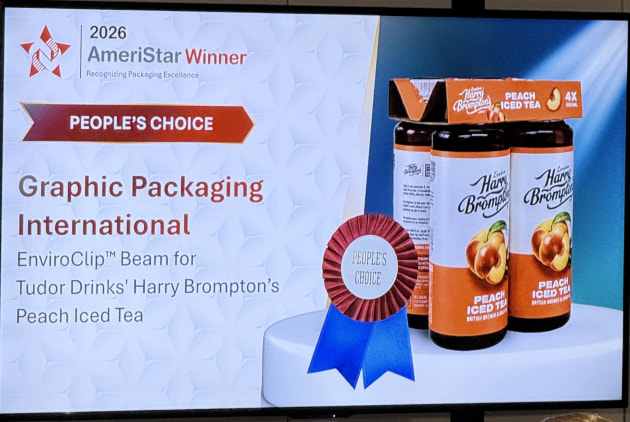
People’s Choice went to Graphic Packaging International’s EnviroClip Beam for Tudor Drinks’ Harry Brompton’s Peach Iced Tea – a glue-free paperboard clip that took the independent brand into a retail-ready four-pack.
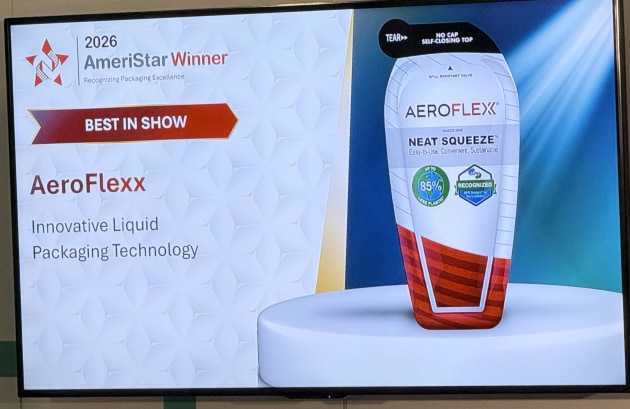
Best in Show went to AeroFlexx, whose mono-material liquid pack uses air chambers instead of thick plastic walls to give it shape and strength, with up to 85 per cent less plastic. It also won the Design Excellence and Health and Beauty categories.
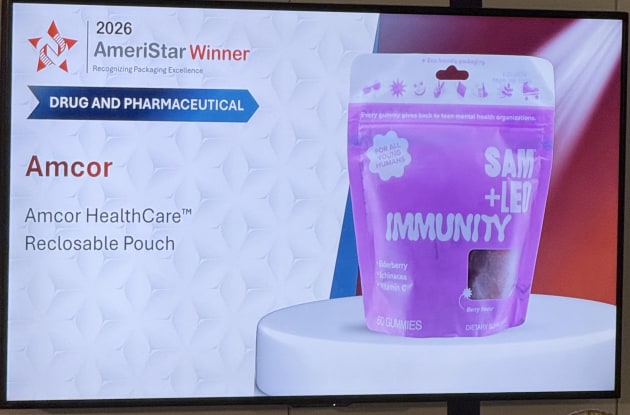
My personal pick is the Amcor HealthCare reclosable pouch, winner in Drug and Pharmaceutical. Made with recycle-ready film, it replaces plastic bottles for gummy vitamins, features a child-resistant zipper, and according to Amcor’s life cycle assessment has an 83 per cent lower carbon footprint than a standard PET bottle.
The takeaway
If one message came through loud and clear in Chicago, it’s that sustainability and efficiency are no longer separate conversations. Whether it’s paper replacing plastic, lighter handles and closures, or robots and AI squeezing more out of every line, the innovations drawing the crowds were the ones that cut material and cost at the same time – with regulation such as PPWR and EPR adding urgency. Many of these technologies are already finding their way to Australia and New Zealand, and PKN will be following them closely. Look out for my full Pack Expo report in the next print issue of PKN.


