Research in the use of bioplastics in enhancing water and food security will be a major focus of the Australia's Cooperative Research Centre for Polymers (CRC-P) following the announcement of a five year extension for the centre and the injection of extra funding into the scheme.
The head of the AusIndustry division within the Department of Industry, Innovation, Science, Research and Tertiary Education, Chris Butler, has announced extra funding of $14.5 million for the CRC-P to support the five year extension of its activities.
He said that with further resources provided by its participants, the CRC will have a war chest of $60 million to conduct research to assist Australian manufacturing.
The CRC was established under the Australian Government’s Cooperative Research Centres program in 1992. The CRC-P has a strong track record of developing technologies for the plastics industry.
The CRC-P includes five companies – Virbac Australia, BASF, BlueScope Steel, Mesoblast and Integrated Packaging – as well as eleven universities, CSIRO and ANSTO among its 23 participants.
More than $9 billion worth of polymers and polymer-based products are used annually in almost all sectors of the Australian economy.
The extra funding will be used to fund research in three main areas – health therapies and delivery, water and food security, and low-cost solar energy.
“The CRC will build resilience into Australian manufacturing by improving sustainability and product innovation, increasing its international competitiveness,” the CEO of the CRC-P, Ian Dagley, said.
“The benefits will include productivity gains, increased sales of Australian-made products, high-skill high-value manufacturing jobs, reduced carbon dioxide emissions and 40 broadly trained polymer researchers.”
The launch of the new funding and extension of the CRC's activities was held at a Melbourne production site of Integrated Packaging Group (IPG).
IPG's previous research with the CRC has resulted in improved technology to control the degradation of plastic films in the environment.
One application of this technology now being evaluated by IPG in collaboration with Greening Australia and the Birchip Cropping Group is the mechanical application of degradable film over the seeds of native trees at the time of planting.
The film provides a temporary greenhouse that allows earlier planting, assists germination, improves water use efficiency and reduces pest damage.
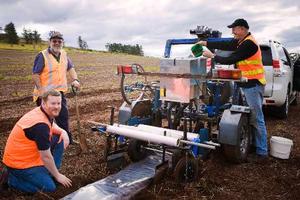 Australia's Cooperative Research Centre for Polymers conducts research on plastics and bioplastics, including projects to help farmers better protect their crops.



