The convergence of social, demographic, ecological and technological trends driving developments in the world packaging industry came under the spotlight when brand owners, retailers and packaging technologists gathered in Melbourne last week for the two-day World Class Packaging conference.
Organised by Marcus Evans, and counting PKN as its media sponsor, the conference presented delegates with a snapshot of the key factors impacting packaging design, development and manufacture today and into the future.
Keynote speaker, the director of procurement for technology company Dell, Oliver Campbell, set the tone of the conference when he highlighted the increasing role sustainability will play in packaging policies for companies such as his own.
Pointing to the projected growth of the world population to reach eight billion people by 2025, with its resulting pressure on global resources, Campbell said attention to sustainability in packaging was an issue companies could not ignore.
“It [sustainability and innovation] is very much needed – it is good for people, good for business and good for the planet,” he told attendees.
He outlined the role and achievements of Dell's Legacy of Good program, which is aiming to achieve a zero waste goal for the company's packaging by 2020 through use of recyclable or compostable packaging made from such materials as wheat straw and mushrooms.
Follow-up speakers continued the theme.
Group packaging manager for food giant HJ Heinz, Cameron Dellar, spoke of the need for collaboration to embed sustainable practices and materials in packaging to ensure they meet increasing environmental expectations by consumers.
“It is about the materials we use, which is critical to how we look at our global footprint,” he said.
While HJ Heinz had succeeded in reducing the varieties of plastic materials it used in its packaging from eight down to four and increased its use of bioplastics such as Green PET, Dellar said this had involved substantial changes to its manufacturing practices.
“Each of these steps involved new materials or different proportions of materials, changing production processes dramatically,” he said.
“That means, when new products are developed in the future, there will need to be more collaboration between brand owners, packaging designers and the machinery manufacturers.”
Also representing the food industry, packaging specialist with Nestlé Australia, Nina Cleeve-Edwards, spoke of the need to follow a more holistic approach, especially the use of Life Cycle Analysis (LCA), to gauge the true impact of sustainable packaging projects.
She pointed to a disconnect in widespread assumptions about packaging, noting that while consumers tended, wrongly, to view packaging in an environmentally negative light, sustainable packaging trends, including increased recycling and bioplastics, were often not as “green friendly” as supposed.
Recycling of packaging, for example, often consumed too much power to make it viable, while bioplastics need more development to reach the economies of scale required to make them commercially successful in a majority of applications.
RMIT Centre for Design researcher and PKN columnist Dr Karli Verghese, also addressed the mismatch between consumer perceptions about packaging and its ecological impact, outlining studies showing packaging was in fact a major factor in cutting back on food waste.
The conference drew to a close with a look forward to the digital tools increasingly being adopted to streamline packaging design and make it more responsive to consumer needs.
Esko Graphics business development manager, Antony Conway, travelled from Singapore to present an overview of digital tools for new product development, enabling rapid prototyping and approvals of new pack structures and materials.
He spoke of the need of such techniques to more easily manage developments in packaging structural design and packaging materials that to date are outpacing the industry's ability to make best use of them.
“The question for many in the packaging industry is: Are we innovating too quickly? And in many cases this is indeed so,” he said.
“We are developing things like bioplastics, where there is not the infrastructure out there yet to make best use, or disposal, of them.”
* PKN will present more detailed coverage of presentations to the World Class Packaging conference in its January-February 2014 edition.
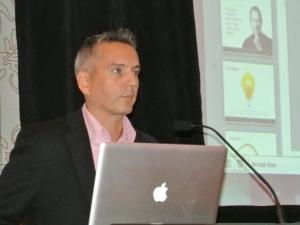 Esko Graphics' Antony Conway addressed the role of digital tools in the future development of packaging design.



