New Zealand's Admark Visual Imaging, one of Australasia’s leading manufacturers of printed graphics, has become the first printer in the region to install the Epson SurePress L-4033A short run digital label press.
Established in 1971 as a screen printing company, Admark has more than 50 employees in offices in Hamilton, Auckland, Wellington, Rotorua and Sydney, and specialises in large format digital printing, label printing and screen printing
About one third of Admark’s print volume is labels and 80 per cent of all its label work is for the food and beverage sectors, with the remainder being industrial.
The company's managing director, Laurie Pilling, said the decision to invest in the new short run printer was prompted by increasing customer demand for short run label print jobs.
The company had previously relied on letterpress and flexographic printing equipment. Pilling said, however, short runs simply weren’t profitable using such technology.
“The main challenge we faced was in identifying a digital label print solution that would give us – and our customers – top quality output,” he said.
“The quality of print and colour from the SurePress is such that we can now spread heavy workloads across flexo and the SurePress without any discernible difference.”
He said the biggest test of the printer's output came when he presented clients with the same label, printed on both systems, and asked if they could notice any differences.
In each case, he said, the answer was 'no'. He added that the production time and costs for many short run jobs had been substantially reduced.
“To do a short run of 5000 labels on flexo the printing time would take only 15 minutes, but there’s the additional overhead of two hours for mounting the plates and setup, then, at the completion of the job, washing the plates and cleaning up,” Pilling said.
“On top of that, there are tooling costs, all of which have to be passed on to the client. So by eliminating the costs and dramatically reducing production time, we’re now passing cost savings on to the client and turning many jobs around in a fraction of the time and at short notice.”
He said the investment proved its worth in particular in a bottle label job the company did for one of New Zealand’s leading winemakers.
“Each of the labels had to be individually numbered and to do this on a normal press would have been unrealistic. Instead we ran the entire label through the SurePress in one pass, using variable data for the numbers,” Pilling said.
Designed for label converters taking the first steps into digital printing or expanding their existing digital printing capacity, large scale product manufacturers and commercial printers, the SurePress L-4033A fits into existing digital workflows and is offered with a range of third party pre-and post-press options.
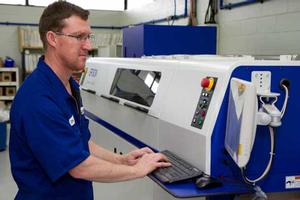 SurePress operator Tim Radcliffe at work on Admark's new short run printer from Epson.



