


Henkel Australia has officially opened the upgraded Innovation and Application lab in Seven Hills, Sydney, with the new facility targeting key growth sectors in Australia and New Zealand, such as food and beverage, packaging, and general manufacturing and maintenance.
Henkel operates globally with a well-balanced and diversified portfolio within three business units (adhesives, sealants and functional coatings) in both industrial and consumer businesses.
“The upgrading of our Innovation and Application lab allows us to test and tailor solutions to meet the requirements of the local market, ranging from the latest in product design and food safety standards to adapting to a circular economy,” said Daniel Rudolph, president of Henkel Australia and New Zealand.
“Our upgraded Innovation and Application lab in Sydney enables us to offer the latest product innovations to the market,” added Mark Dorn, president of Henkel Asia-Pacific and global head of Craftsmen, Construction and Professional division, Henkel Adhesive Technologies.
“From food safety and sustainability for the packaging industry to raising the standards in engineered wood production, we are excited to offer game-changing solutions to our customers.”
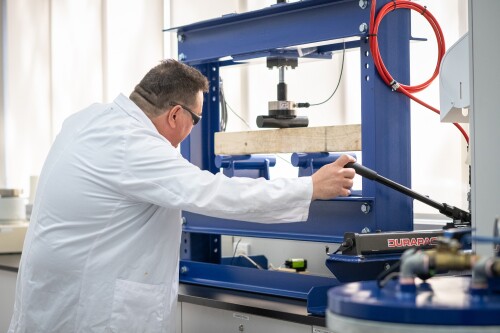
The lab is co-located at Henkel’s adhesive manufacturing facility, which facilitates a rapid transition and reduces the time to market from product concept and development to volume production.
Using state-of-the-art equipment, the lab conducts performance testing of customers’ samples to meet the international standards for engineered wood, namely AS/NZS 1328 for glue laminated timber and AS 5068-2006 for timber finger joints in structural products.
Henkel is also able to validate the performance of new primer and wood species with its own adhesives. Also, with the Anton Parr rheometer, Henkel chemists can stringently test complex rheological behaviour in food packaging solutions.
Looking ahead, with its polymerisation capability, the lab is exploring developing customised water-based technologies for the Australian and New Zealand markets.


