


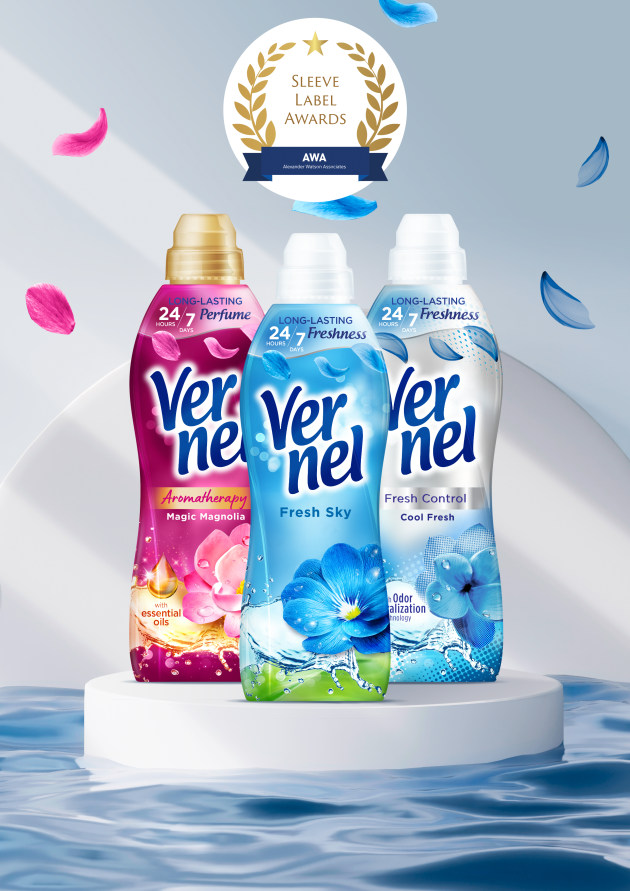
Henkel and global specialty packaging company CCL have won the AWA (Alexander Watson Associates) Sleeve Label Award in the category ‘Environmental Contribution’ for their sustainable design of Henkel’s Vernel fabric softener bottle.
To improve the recyclability of the PET bottle bodies of its fabric softeners in Europe, Henkel partnered with CCL, who has developed a new generation of floatable polyolefin material for shrink sleeves called EcoFloat.
EcoFloat is a low-density material that can be separated from PET bottle components during the sink-float separation process at recycling facilities.
While the heavier bottle material sinks to the bottom of the water baths, the lightweight sleeve material floats to the top, even with full printed designs.
This enables a clean separation of the PET and the label material, which is necessary to gain high-quality PET recyclate.
“The bottle body of our fabric softeners in Europe already consists of 100 per cent recycled PET. Using the new sleeve material, it is now also designed for recycling,” said Abdullah Mahmood Khan, head of global R&D packaging for Fabric Enhancers at Henkel.
“Many consumers don’t remove the sleeve before discarding the bottle, which mostly means that the bottle cannot be recycled either. We have now found a solution to enable the recycling of our bottle bodies in this case.”
CCL offers a portfolio of sustainable solutions for labels and sleeves that enables customers to meet their sustainable packaging goals.
“The collaboration with Henkel is a great example of how a primary packaging can be improved through advanced sustainable technologies,” said Lukas Nachbaur, key account manager for Henkel at CCL.
“With all packaging solutions that we offer, we always ensure that they comply with the official design for recycling guidelines of organisations, such as RecyClass in Europe and APR in the US.
“In this case, Henkel’s new packaging design adheres to the specific EPBP guidelines for PET bottles.”
Henkel is using the new sleeves in about half of its fabric softener product portfolio in Europe.
The project pays into Henkel’s packaging targets by 2025, which include that 100 per cent of Henkel’s packaging will be designed for reuse or recycling.
The company also aims to reduce the amount of virgin plastics from fossil sources in its consumer products by 50 per cent by increasing the proportion of recycled plastic to more than 30 per cent, and reducing the overall packaging volume.


