


Australia's emerging soft plastics recycling infrastructure is ready to process significantly more material, according to Soft Plastic Stewardship Australia (SPSA), which has launched a three-month campaign aimed at boosting consumer returns and strengthening domestic supply of recycled resin.

The industry-led stewardship organisation says the successful commissioning of new recycling infrastructure, including iQRenew's Soft Plastic Engineered Commodity (SPEC) facility in Taree, NSW, marks a significant milestone for Australia's circular economy. The challenge now, it says, is securing enough feedstock to keep the system operating at scale.
SPSA chief executive Barry Cosier said the industry had reached an important turning point.
"This marks a pivotal moment, preventing thousands of tonnes of material going to landfill and demonstrating that Australia has a proven, scalable and commercially viable recycling pathway," Cosier said.
The timing is significant. Soft plastics recycling is increasingly being viewed through the lens of supply chain resilience as manufacturers seek ways to reduce exposure to imported virgin resin and global market volatility.
According to SPSA, increased soft plastic recovery could save the equivalent of 100,000–150,000 barrels of oil annually by displacing imported virgin plastics with locally recycled material.

"We're calling on all Australians to bring their confectionery wrappers, chip packets, frozen vegetable packets, bread bags, pasta packets, biscuit wrappers, and other clean, dry soft plastics back to participating stores over the next three months.
"The new recycling capacity is equivalent to saving 100,000–150,000 barrels of oil per year, reducing Australia's exposure to current global oil and virgin resin price volatility – a key driver of packaging costs," Cosier said.
Infrastructure now in place
The call to action follows the commissioning of the SPEC facility in Taree, developed by iQRenew with support from the Recycling Modernisation Fund, the Soft Plastics Taskforce and private investment.
The facility is producing recycled resin suitable for food-grade packaging, rigid bottles, saveBOARD panelling and timber replacement products, demonstrating a viable end market for recovered soft plastics.
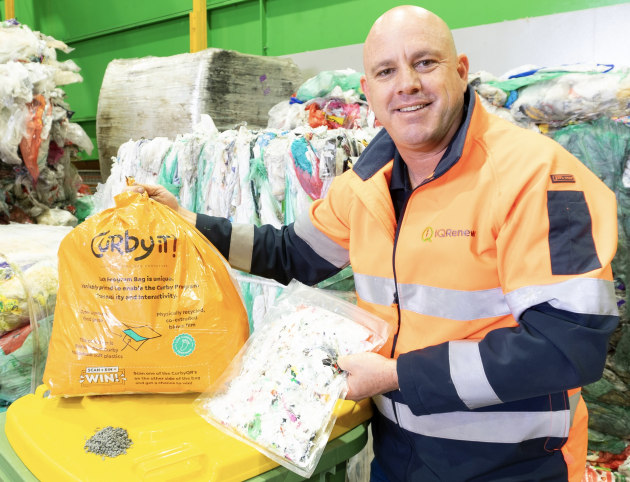
iQRenew chief executive Danial Gallagher said the technology had moved beyond the pilot stage and was already delivering commercial outcomes.
"With government and supermarket support, we have designed, built, and now operate a world leading soft plastic recycling facility and are now producing high-quality recycled pellets for food grade packaging, rigid bottles, saveBOARD panelling and timber replacement products.
"The technology has been operating since 2024. The technology is proven. Now it needs feeding."
The facility was established following the processing of stockpiled material from the former REDcycle program and is now seeking ongoing supply through established collection networks.
A stronger case for recycling
SPSA argues that recovering soft plastics is as much an economic issue as an environmental one.
Australians consume around 300,000 tonnes of imported soft plastic packaging each year, which SPSA conservatively values at more than $500 million. Once discarded, that material attracts an estimated $100 million in landfill disposal costs.
"We import material with real commercial value, use it once, and weeks later it's a near-worthless waste stream the community pays again to landfill," Cosier said.
"Waste is simply uneconomic and adding to the cost of living. Recycling keeps value in Australia and reduces long-term costs for households and industry."
SPSA director and Nestlé Oceania general manager confectionery and snacks Andrew Lawrey said recycled resin had an important role to play in strengthening Australia's manufacturing capability.
"Recycling soft plastics isn't just good for the environment – it's economically smart. Recycled resin reduces reliance on imported virgin plastics, frees up global capacity for food grade packaging and strengthens Australia's food security.
"This is exactly the kind of sovereign capability that Future Made in Australia is designed to support."
Three-month challenge begins
To increase feedstock supply, SPSA has launched a three-month collection challenge encouraging Australians to return clean, dry soft plastics through participating supermarket collection points.
The organisation is targeting everyday households, families and sports fans during a period that includes major sporting events such as State of Origin, AFL fixtures and international football tournaments, which typically drive increased consumption of packaged snack foods.
Consumers are being encouraged to collect and return confectionery wrappers, chip packets, frozen vegetable bags, bread bags, pasta packets and biscuit wrappers, while sharing their participation through social media.
Research cited by SPSA indicates that 94 per cent of Australians support convenient soft plastics recycling. The organisation plans to expand beyond its current network of around 700 collection points and increase kerbside bag-in-bin collection systems.
However, SPSA argues that greater regulatory certainty, including stronger producer responsibility measures and recycled content mandates, would accelerate both collection and investment.
For the packaging industry, the campaign represents a notable shift in the conversation around soft plastics. After years focused on collection systems, stockpiles and processing capacity, the industry now has operational infrastructure producing recycled resin. The challenge, SPSA says, is ensuring enough material is returned to keep that infrastructure supplied and Australia's recycling ambitions moving forward.
The bigger picture
Recent disruptions in global resin markets have highlighted Australia's dependence on imported virgin polymers and the vulnerability that creates across packaging supply chains.
As PKN reported earlier this month, industry leaders including Pact Group, Nestlé Oceania, Woolworths and Martogg pointed to the role domestic recycled resin can play in reducing exposure to global supply disruptions while strengthening local manufacturing capability.
SPSA's latest campaign adds another dimension to that conversation. The industry now has operating infrastructure capable of producing recycled soft plastic resin at commercial scale. The challenge is ensuring sufficient material is returned to keep those facilities supplied.
In that context, soft plastics recycling is no longer only an environmental issue. It is increasingly becoming part of a broader discussion about sovereign manufacturing capability, resource security and packaging supply chain resilience.


