


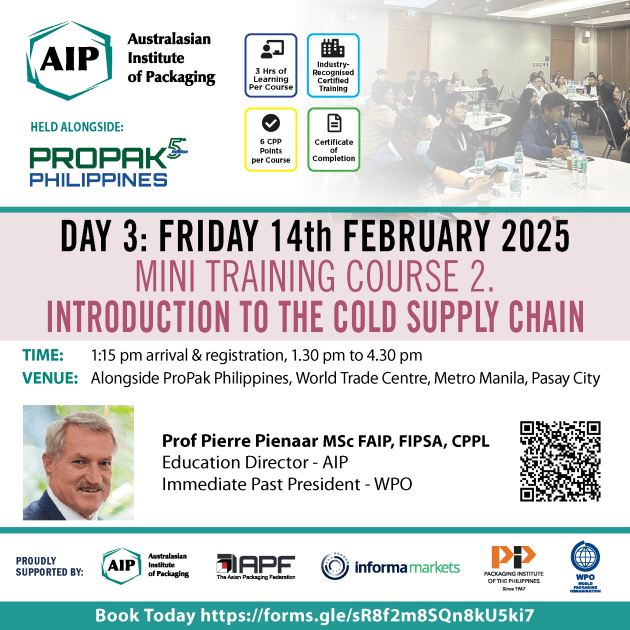
The AIP will be offering two globally recognised mini training courses on 12 and 14 February 2025 at ProPak Philippines.
The first course offered will be an Introduction to Packaging Specifications, with the second course an Introduction to the Cold Supply Chain.
All attendees will receive a Certificate of Attendance and also six points per course towards attaining/maintaining the global Certified Packaging Professional (CPP) designation.
The lecturer for both training courses will be Prof Pierre Pienaar, education director of the AIP and immediate past president for the World Packaging Organisation (WPO).
- Introduction to Packaging Specifications: Wednesday 12 February
A specification is a legal document between supplier and user and is necessarily comprehensive in terms of detail, physical characteristics and material composition, as well as performance in the packaging process and subsequently to the final point of receipt (the end user).
Key factors in the preparation of specifications are the use of language and appropriate technical terminology and mensuration. Appropriate reference should also be made to recognised procedures (such as ISO standards) for the assessment and performance of packaging materials.
The course will cover basic specifications to the more complex requirements associated with the performance of packaging within the packaging line.
The course is designed for those charged with the responsibility of the preparation or monitoring of specifications such as purchasing officers, packaging technologists and designers, production personnel, etc.
This course will address the clear and correct use of language and terminology in the preparation of specifications.
- Introduction to the Cold Supply Chain: Friday 14 February
Preliminary and conservative estimates put the cost of food waste within the cold food chain at $3.8 billion at farm gate values, which means we need to gain an understanding of the extent, and the costs associated and set up systems for opportunities for improvement.
Lack of understanding of the importance of temperature is one of the main reasons for food wastage, with the greatest risks for perishable food occurring during transportation and handling between mobile and stationary refrigeration points.
There are also sometimes significant temperature variations between truck or trailer, loading docks and storage facilities.
Delegates attending this course will become familiar with the causes of food wastage in the cold chain, to help improve cold chain processes and standards, as those involved in packaging need to work towards a universally adopted code to help all cold chain practitioners lift their compliance record.
Attendees will:
- Understand the mechanisms and need for a suitable cold supply chain.
- Understand the design and implementation of a good workable cold supply chain system.
- Gain insights as to why cold supply chain is important and how best to rectify current shortfalls.
- Obtain an understanding of the part that packaging people play in the cold supply chain.
- Gain knowledge of the cold supply chain in order to make the right decisions related with food loss and waste.
Retailers, manufacturers, businesses interested or involved in cold supply chains should attend, as well as any business in packaging looking to enact change to avoid food wastage in the cold supply chain.
Those who work in Supply Chain & Logistics, Transport & Distribution, Packaging, Procurement and Operations are encouraged to attend.
Limited places are available. Click here to book your spot.


